Refrigerator Repair · Edmonds
Blocked by a Train: Scheduling Appliance Service on the Wrong Side of the Edmonds Tracks
Every road to the Edmonds waterfront crosses the railway at grade. How a Sub-Zero visit west of the tracks is planned, and why the rest of Edmonds is not.
By Marta Fennimore Refrigeration technician — ice systems and water supply · 12 years in the trade EPA Section 608 certified
What people here assume is wrong with it
Homeowners in the Bowl assume the hard part of a refrigeration repair is the diagnosis. Down here it is the second trip. A technician who has crossed to the waterfront, found the fault and needs one part can be stopped on the wrong side of a freight train for the rest of the arrival window, and a stopped train does not publish an ETA.
Every vehicle route to the Edmonds waterfront crosses the BNSF mainline at grade — at Main Street and at Dayton Street, and nowhere else. A city-appointed task force examining growing rail traffic found the waterfront can be blocked for extended periods, and that emergency vehicles have no access west of the tracks while a train is sitting across them; its recommendation was a dedicated emergency-access overpass, the Edmonds Waterfront Connector. The Edmonds–Kingston ferry loads across the same corner of downtown, so on a bad afternoon the holding queue on SR-104 is doing to the street grid what the train is doing to the crossings.
Westgate, Perrinville and Seaview carry none of that. Same city, same appliances, completely different logistics.
What is actually happening
Inside the cabinet, none of this matters. What matters is that two Sub-Zero complaints can look identical from the kitchen and be nothing alike underneath.
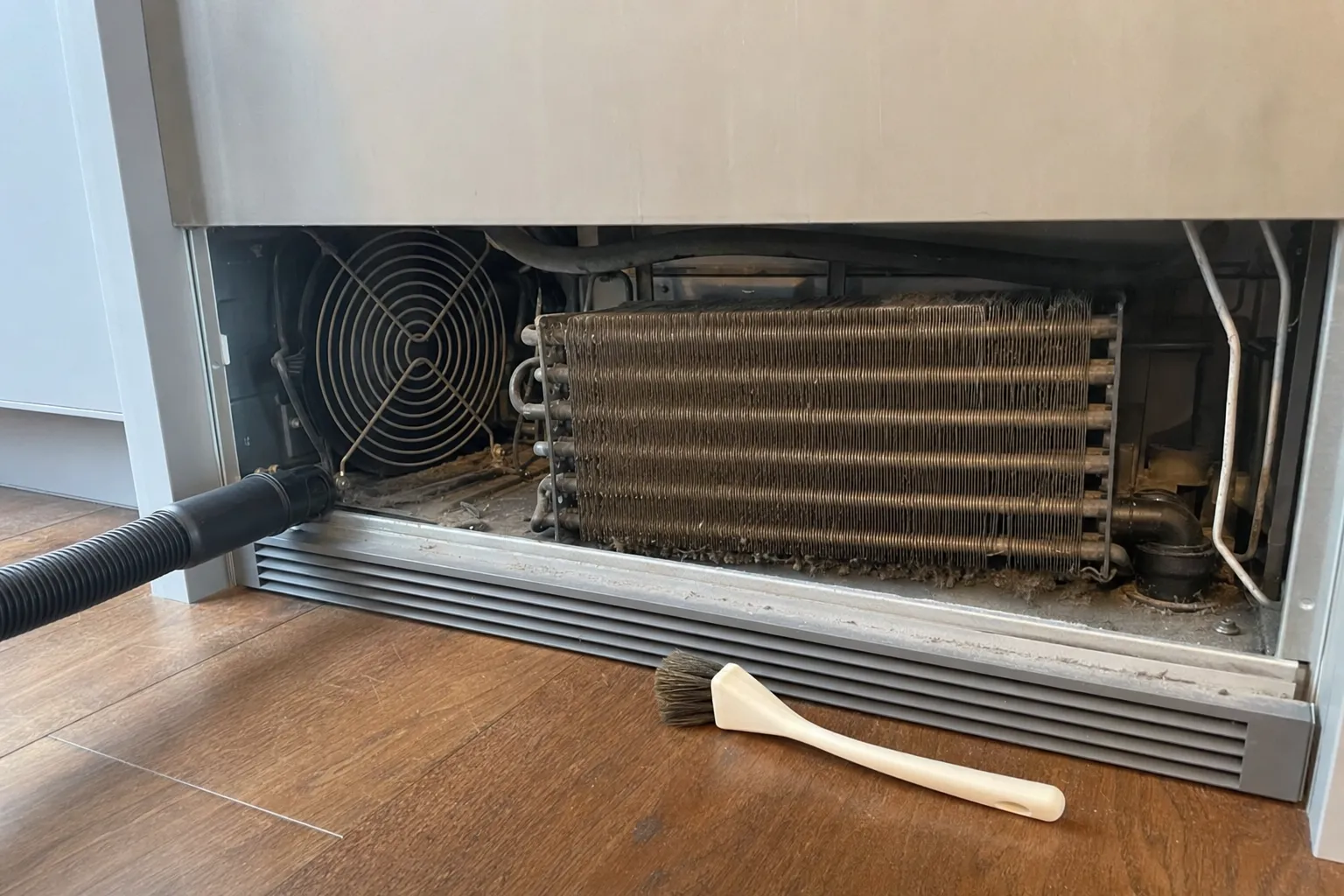
A fresh-food compartment sitting near fifty degrees overnight while the freezer stays rock solid is not necessarily a compressor. In a built-in that cools each section with its own system, that split sends the search to the fresh-food side, and its airflow is checked before its compressor: an evaporator fan that has stopped or slowed, or a coil that has iced over and blocked itself. A compressor that never shuts off, with a grille area warm to the hand, is the other family entirely — heat rejection. That is a condenser that cannot dump its load, whether from a fouled fin pack, a failed condenser fan, or a refrigerant charge problem behind both.
Where the address does reach the appliance is corrosion. Downtown condos a few hundred feet off the water, and the bluff-side houses in Seaview, run their condensers on salt-laden air, and salt eats at the thin metal of a coil until it sheds heat less well. Water pooling under the crisper drawers and refreezing into a sheet is a drain and defrost story, and a door alarm that sounds on a properly closed door is usually a switch or a seal, not a fault in the cooling system at all.
The evidence, in the order we look at it
The order is deliberately front-loaded, because on a waterfront call we want the whole picture established before anyone has to cross the tracks again.
We start with two cabinet temperatures taken with our own probe, then pull the grille and read the condenser: fin condition, blade, and whether the fan is commanded and running. We measure compressor run time rather than guessing at it. Then the freezer side comes apart far enough to see the evaporator — a coil buried in frost tells you the defrost circuit failed weeks ago, and a clean coil with a dead fan tells you something completely different. Heater resistance, sensor values and termination behaviour get measured, not assumed. The drain gets checked for the ice plug that produces the sheet on the cabinet floor. Doors, hinges, seals and switches last, along with the alarm circuit.
The scheduling method matters as much as the diagnostic one. For an address west of the tracks we ask for the model and serial before the visit so the likely parts ride along; we complete the full diagnosis in one pass rather than crossing back for a second look; and we book downtown work with the crossings and the boat in mind rather than pretending the map is flat. If you are in Downtown Edmonds, tell us when you book — it changes the window we offer.
The fix that holds
A repair holds when the cause behind the symptom is dealt with, not just the failed part. A defrost heater replaced without correcting a clogged drain will ice the floor of the cabinet again by spring. A condenser fan motor swapped into a corroded fin pack that was never cleared will run hot from the day it goes in. On the water side of town that means the coil gets cleared and the blade cleaned as part of the job, and gaskets that have taken a set get replaced rather than coaxed.
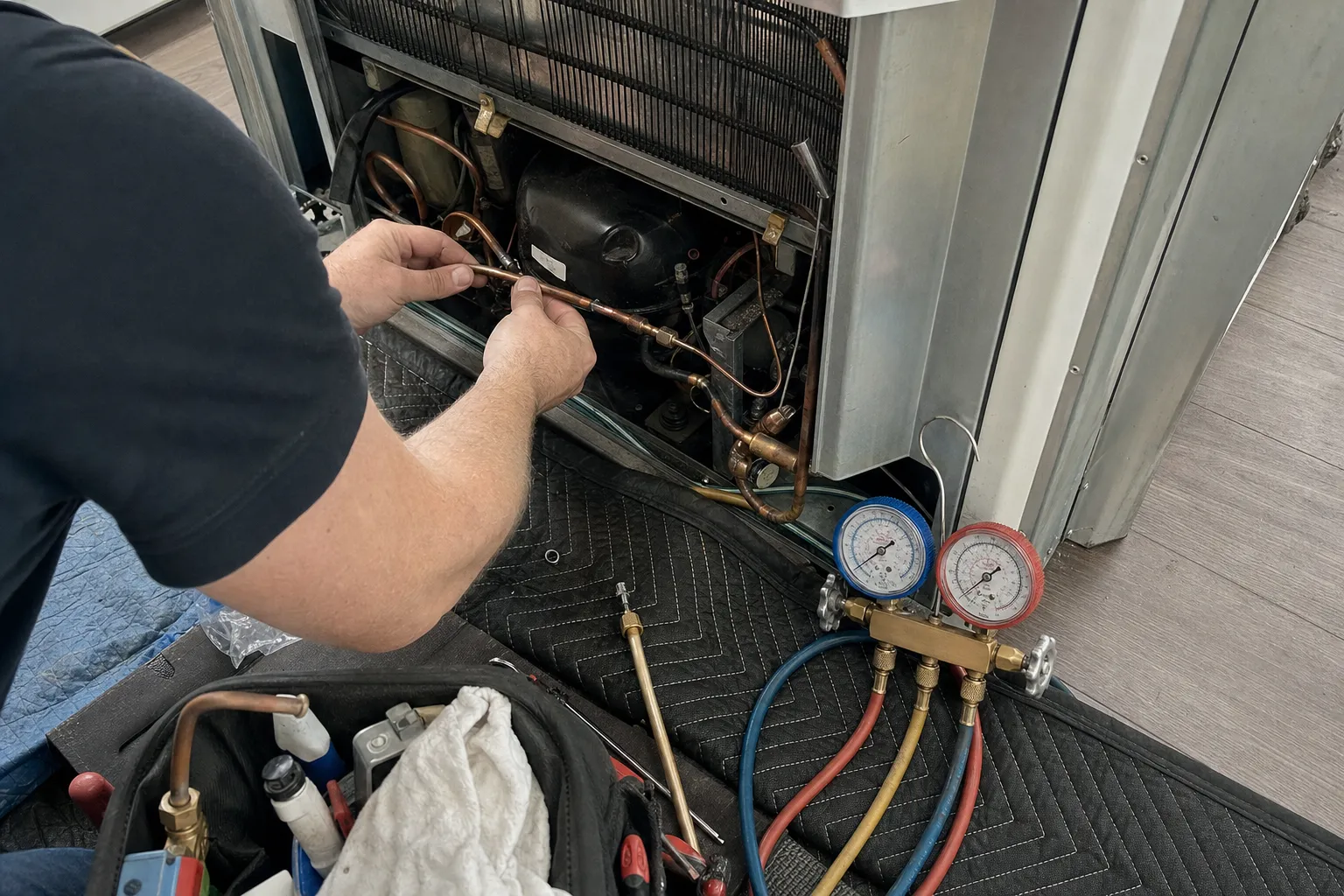
Every one of those jobs has its own published price range, and the figure is agreed before the work starts. The sealed-system range is the highest, and it is the one we prove with gauges rather than assume.
Where to stop and call
Stop as soon as the fresh-food side climbs past 40°F and stays there — the FDA’s line is four hours above that for perishables, so at that point you are managing food safety, not a nuisance. Stop when ice keeps returning to the cabinet floor after you have melted it, when the compressor has not cycled off in twenty-four hours, or when the door alarm keeps sounding on a shut door. Those are not settling-in noises.
The diagnostic visit is $89 and it ends with a named fault and a price, not a range of possibilities. Mention on (206) 210-3547 what you have already tried; it shortens the visit. If the property is in the Bowl, mention parking and whether there is alley access — the technician plans the crossings around it.
Common follow-ups
Can you actually get to my condo in downtown Edmonds if a train is blocking Main and Dayton?
Not while it is there: those two crossings are the only road routes to the waterfront, with no detour. So the visit is planned around them, with the model and serial taken in advance, the likely parts brought along and the whole diagnosis done in one crossing. Tell Sub-Zero Repair Edmonds, (206) 210-3547, that you are west of the tracks.
Why does salt air matter more in Seaview and the Bowl than in Perrinville?
Because the condenser lives on room air, and room air near the water carries salt. Salt attacks the thin metal of the coil, which then sheds heat less well, so running temperatures creep up before anything actually breaks. It does not mean waterfront units fail early, only that the condenser deserves a look sooner on this side of town.
My freezer is fine but the fresh food side is at fifty. Is the compressor going?
Not necessarily. When one compartment holds temperature and the other does not, the freezer's system is plainly working and the fault sits on the fresh-food side. Sub-Zero's service manual has that side's fan and a frosted-over coil checked before its compressor, and both of those are priced in ranges well below sealed-system work.