Repair or replace
The Compressor Failed. Fix It or Replace the Unit?
- Signed
- Dean Halvorsen
- Role
- Refrigeration technician — sealed systems and airflow
- Certification
- EPA Section 608 certified
- Published
Straight answer
Usually fix it. Replacing the compressor on a built-in is sealed-system work, priced in a range far below a comparable new unit, and you keep the cabinet, the doors and any custom panels. It stops making sense when the cabinet itself is failing. Sub-Zero Repair Edmonds prices both before anything is ordered: (206) 210-3547.
To replace it
$12,110–$21,200
a like-for-like new built-in, with the fitting and any cabinet work still to pay on top
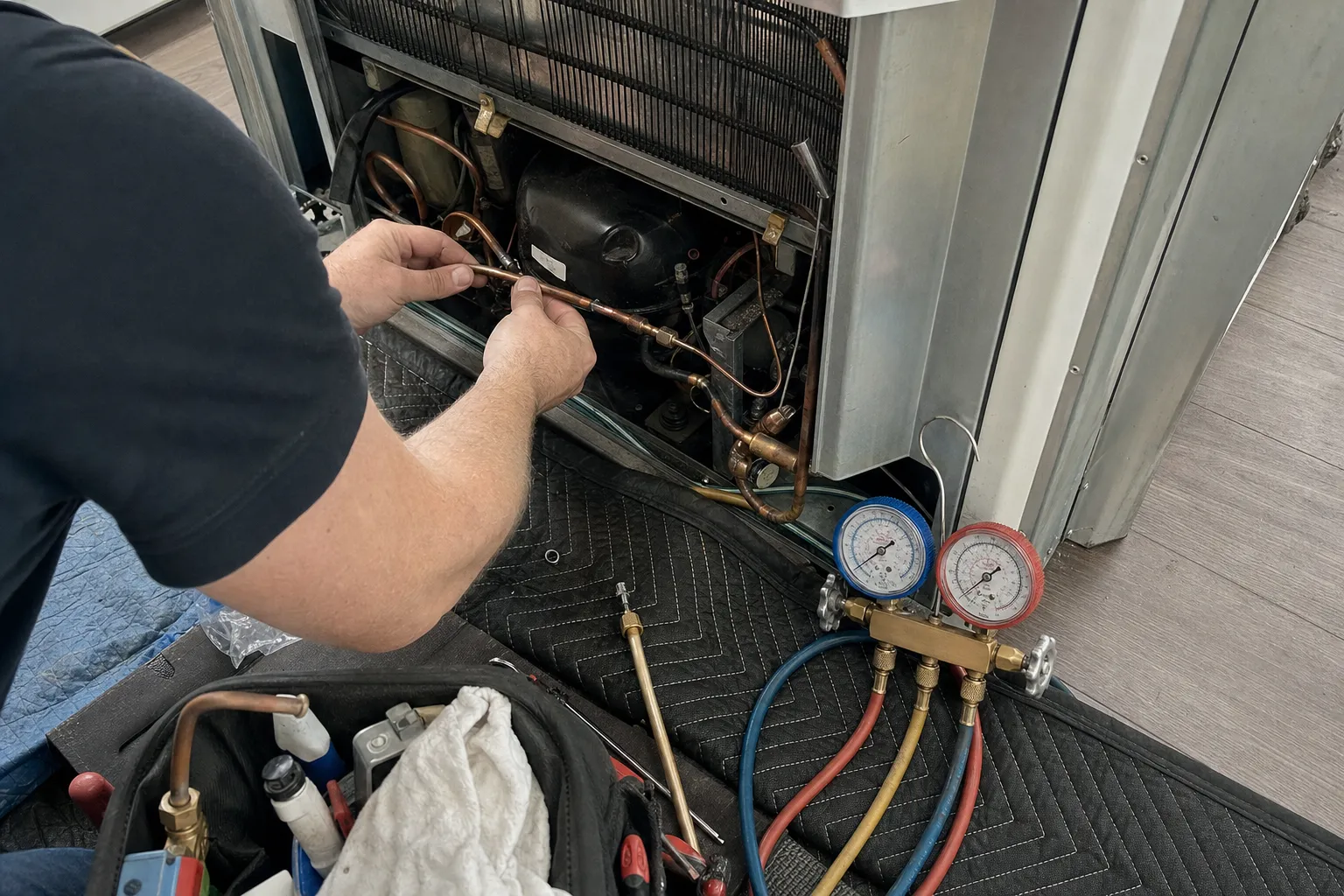
Why the sum usually favours repair
The compressor (the pump that drives refrigerant around the sealed system) is the dearest single part in a refrigerator, which is why its failure sounds like the end of the unit. It seldom is. The repair range above is for the whole job, parts, refrigerant and labour included. The replacement figure beside it is before anyone has taken the old unit out, fitted the new one or touched the cabinetry around it.
Repair also keeps what is hard to replace: the cabinet and its insulation, the doors and hinges, the shelving, and any panels made to match the rest of your kitchen.
When the same sum tips the other way
The comparison turns against repair when the box around the compressor is failing: a liner that has cracked, doors that no longer pull shut against their gaskets, rust creeping into the frame. Money spent on a new compressor does not fix any of that.
It also turns when this would be the second sealed-system repair in a short span. One failure is bad luck; two close together usually mean something else in the system, or in the way the unit is installed, is working against it.
Age on its own is not on either list. A well-kept older unit with a sound cabinet is a better candidate for a new compressor than a younger one that has been starved of air for years.
One compressor or two
Sub-Zero’s built-in combination models cool the fridge and the freezer with two separate systems, each with its own compressor. When one fails, the other section usually carries on as normal, which buys time: you can decide with the numbers in front of you rather than with a warm kitchen and a cooler full of food.
Repair makes sense when
- The cabinet, doors and gaskets are sound, and the fault is confined to the compressor on one of the unit's systems.
- The unit has never had a sealed-system repair, so this would be its first.
- Custom panels or a tight opening would turn any replacement into a cabinetry job as well.
Replace it when
- The liner is cracked, the doors no longer seal or rust has reached the frame: a new compressor would sit in a failing box.
- A second sealed-system repair is being quoted only a few years after the first.
- The kitchen is being redone anyway and the opening will be rebuilt to a new size.
What we check first
- That the compressor really is the failed part: power reaching it, and whether it tries to start at all.
- The gauges, read only after the fans, the defrost and the controls have been ruled out.
- The rest of the unit: liner, doors and gaskets, and on a two-compressor model the other section's system.
Questions people ask next
What does a compressor replacement involve on a Sub-Zero?
The refrigerant is recovered, the old compressor cut out and the new one joined into the lines, and the filter-drier is replaced with it. The system is then pulled into a vacuum and recharged with fresh refrigerant, which is why the job is priced as sealed-system work rather than as a part swap. Sub-Zero Repair Edmonds quotes it on (206) 210-3547.
Does a two-compressor Sub-Zero need both compressors replaced?
No. On a built-in combination model each section has its own compressor and its own sealed system, so a failure on the fridge side leaves the freezer's system alone and only one compressor is changed. The other system is still looked over on the same visit, because an older unit that has lost one deserves a careful check of the second.