Freezer Repair · Edmonds
Sub-Zero Freezer Compressor Hot to Touch: Normal?
A freezer compressor hot to touch is usually normal, since compressing refrigerant makes heat. Worry if the freezer warms, it clicks or smells burnt.
By Marta Fennimore Refrigeration technician — ice systems and water supply · 12 years in the trade EPA Section 608 certified

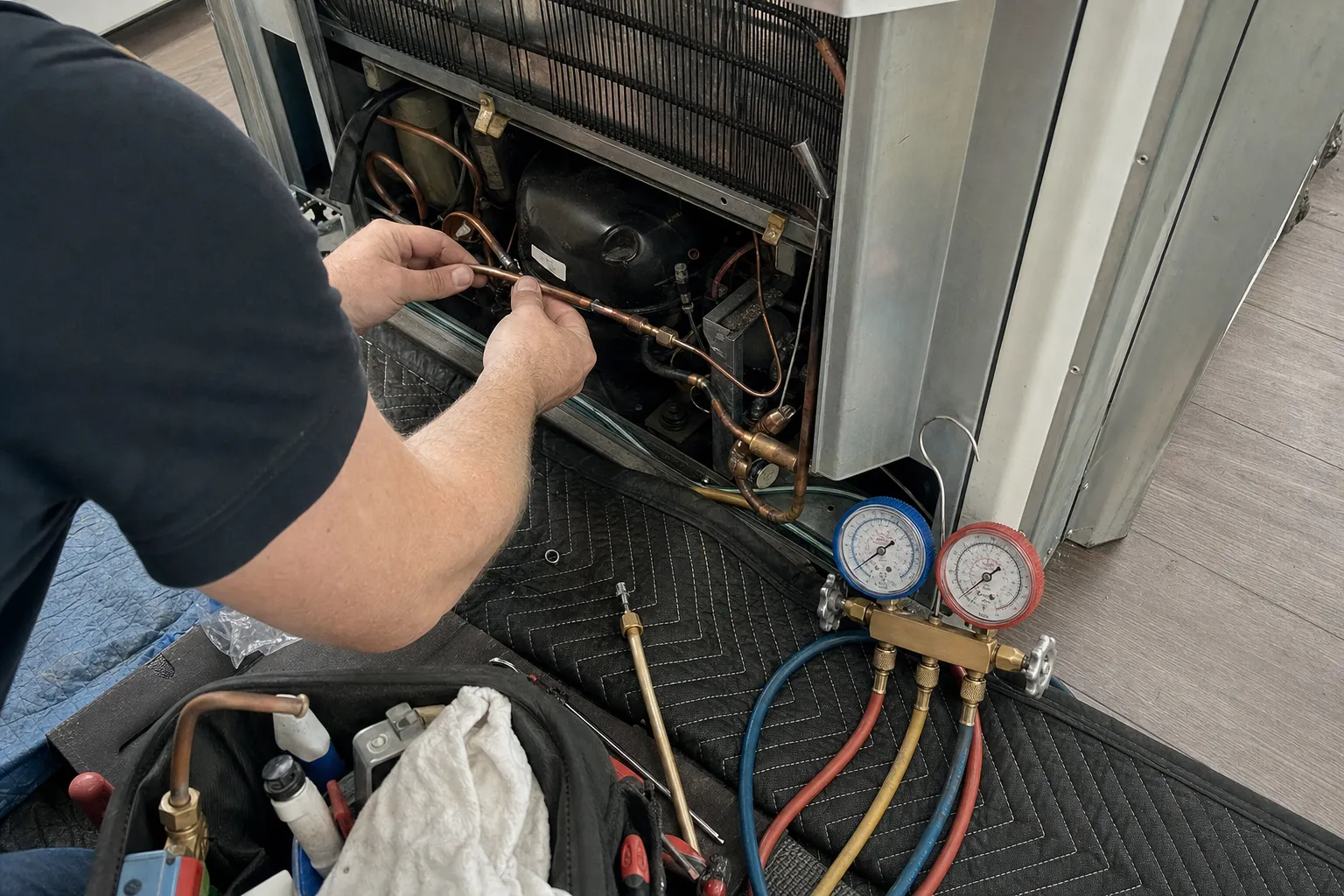
A freezer compressor that is hot to the touch is, in most cases, simply working. Squeezing cold refrigerant vapor into a dense, high-pressure gas generates a lot of heat, and the steel shell of a healthy compressor routinely gets hot enough that you would pull your fingers away after a moment. Heat on its own is not the fault. It becomes one when it shows up with company: a freezer drifting above 0°F, a compressor that clicks off and tries again every few minutes, a motor that never rests, or a scorched electrical smell. In a built-in Sub-Zero set into cabinetry, the line between ordinary heat and trapped heat usually comes down to how freely air can move across the condenser.
What the compressor does, and why it runs hot
Think of the compressor as the pump in a closed loop. It pulls low-pressure vapor out of the freezer’s evaporator, where that vapor has just soaked up warmth from your food, and squeezes it hard. Compression raises the gas temperature sharply. The hot gas then travels through the condenser, where a small fan drags room air across the tubing and fins so the heat can escape into the kitchen. Cooled back into a liquid, the refrigerant flows toward the freezer, drops in pressure and starts absorbing heat all over again.
So the warmth under your palm is the heat pulled out of the freezer plus the heat of the electric motor itself. In many designs the returning vapor also helps keep that motor cool, which is why a compressor starved of refrigerant tends to run hotter rather than cooler. Many Sub-Zero built-ins carry one compressor for the freezer and a second for the fresh-food side, so one can be hot and humming while the other sits idle.
Where the heat comes out on a Sub-Zero
On a Classic (CL) unit the condenser lives up top behind the flip-up grille, and a gentle stream of warm air from that grille is expected whenever the compressor runs. Designer (DET, DEC) units hide the condenser at floor level behind a kickplate fastened with two screws. If the air pouring out of the top feels far hotter than seems reasonable, our page on a top grille blowing hot air explains what that usually points to.
Signs the heat means something is wrong
- The freezer is losing ground. Ice cream turns soft, packages feel pliable, or a thermometer tucked between them reads above 0°F.
- Clicking, then silence, then clicking again. A compressor that cannot start draws heavy current, heats up, and its overload protector cuts it out until it cools. That loop can repeat for hours; see why a compressor clicks and won’t start.
- It never stops. Running almost constantly while the freezer still struggles suggests heat is not leaving the system.
- A burnt or electrical smell, or browned wiring near the compressor. Shut the unit off at the breaker and leave it off.
- A code on the display. On a Classic (BI) model, 60 2 60 means the control detected no freezer compressor load, and 60 2 38 flags a communication fault with the variable-speed freezer compressor. Sub-Zero’s advice for both is a breaker reset followed by a technician.
The usual causes, simplest first
A condenser blanketed in dust
When lint, pet hair and kitchen grease coat the fins, heat stays trapped in the loop, pressures climb and the compressor runs longer and hotter. Federal food-safety guidance from the USDA puts it plainly: an unobstructed front grill lets the condenser breathe, and the coil deserves a pass with a brush or a vacuum a few times every year. Close to the water in Downtown Edmonds, salt-laden air adds its own film to that buildup.
A condenser fan that has quit
If the fan does not turn, the condenser cannot shed heat no matter how clean it is. A seized or sluggish fan motor is a common reason a compressor feels scorching while the freezer slowly warms.
Worn starting parts
Start relays and overload devices wear out. The compressor hums, strains, trips and tries again, and every failed attempt adds heat without moving any refrigerant.
Refrigerant loss or a sealed-system fault
A slow leak or an internal restriction leaves the compressor grinding through long cycles with too little cool vapor coming back to it. Current Sub-Zero literature warns that its appliances contain flammable refrigerant and that only technicians trained for that refrigerant should open the sealed system. Household freezers built to the 2017 UL 60335-2-24 standard may hold up to 150 grams (5.29 ounces) of R-600a or R-290 per circuit, one more reason this is never a weekend project.
A niche that cannot breathe
A built-in squeezed into a tight condo opening, or one whose grille is blocked by trim or stored items, ends up breathing its own hot exhaust.
| What you notice | What it usually means | Who handles it |
|---|---|---|
| Hot shell, freezer at temperature, normal cycling | Normal operation | Nobody |
| Hot shell, dusty grille, long run times | Clogged condenser | Owner |
| Hot shell, no fan sound at the condenser | Fan motor | Technician |
| Rapid clicking, freezer warming | Start parts or compressor | Technician |
| Runs nonstop, freezer slowly warming | Possible leak or restriction | Technician |
What you can check yourself
- Read the display and jot down any code before touching anything.
- Make sure nothing is pressed against the grille or kickplate.
- Clean the condenser: power it down from the control panel first, pull on a pair of gloves, then work a soft brush attachment in the direction the fins run, never across them.
- Restore power and listen near the condenser for the fan as the compressor starts.
- Leave a thermometer among the frozen packages overnight and read it in the morning.
- If a code keeps returning, switch the breaker off for 30 seconds, turn it back on and watch whether the fault clears.
Never spray water into the condenser, straighten fins with a screwdriver or try to bypass a relay. Keep your hands off the copper line leaving the compressor, which often runs hotter than the shell.
When it is a technician’s job, and what it tends to cost
Clicking, burning smells, a freezer that keeps warming after a clean condenser, or any code that comes back all call for a visit. Our $89 visit pays for the complete diagnosis, and that same fee is deducted from the bill once you approve the repair. As a rough guide, a condenser or evaporator fan motor typically costs $340–$700 while a compressor or sealed-system repair typically lands at $1,300–$3,270. You receive a firm quote once the fault is confirmed. A comparable new built-in costs several times the top of that compressor band, which is why a failed compressor is often worth fixing, and weighing a repair against replacement covers the decision in detail. To have a hot compressor checked in Westgate, Perrinville, Seaview or Downtown Edmonds, call (206) 210-3547.
Common follow-ups
Is it normal for a freezer compressor to be too hot to keep your hand on?
Yes, a compressor shell too hot to hold for more than a moment is normal while it runs, because squeezing refrigerant creates heat. Worry only when that heat arrives together with a warming freezer, repeated clicking, nonstop running or a burning smell.
Can a dirty condenser make a freezer compressor overheat?
Yes, a dust-packed condenser traps heat in the refrigerant, so the compressor runs longer and hotter and wears out sooner. On a Classic (CL) the condenser hides behind the flip-up grille, and on Designer (DET, DEC) units it sits behind the kickplate; vacuum it gently with the power off.
Why is my Sub-Zero freezer not cooling while the refrigerator still works?
Many Sub-Zero built-ins give the freezer its own compressor, so a fault in that one circuit can let the freezer warm while the fresh-food side stays cold. A stalled freezer fan, a failed freezer thermistor or the freezer compressor itself are the usual suspects, and each one needs testing rather than guesswork.
Should I switch off a freezer whose compressor feels extremely hot?
Switch it off at the breaker if you smell burning, see discolored wiring or hear the compressor clicking on and off every few minutes. If the freezer is holding temperature and the shell is merely hot, leave it running, clear the grille and clean the condenser instead.
Can I silence the alarm while I wait for a technician?
On a Classic (BI) unit you can quiet a constant chime by pressing ALARM and POWER together and letting go of both in under 5 seconds. That hides the fault indicator for 24 hours but leaves the cause untouched, so write the code down for the visit.